Best Display Cases for Signed Baseballs
If you want the best display cases for signed baseballs, start with the thing that damages them. A signed ball sitting on a shelf is under attack from light, dust, fingers, and sometimes the weight of other objects. A case that handles all four protects the autograph and the resale price. A case that handles only one leaves the other threats working.
This guide sorts cases by what you are protecting: one signed ball, a high-value ball such as a World Series ball, or a shelf of autographed balls. It tells you what to check before you buy, so you can judge any listing yourself without relying on a spec sheet you cannot verify.
Why signed baseballs fade, and what actually causes it
Most of the damage to an autograph comes from light. Ultraviolet (UV) light breaks down the dyes and pigments in ink, and it does so slowly and steadily. A signature that looks sharp today can look pale and brownish after enough exposure, and the change is permanent. Ballpoint and felt-tip signatures are both vulnerable, and which fades faster depends on the ink.
Sunlight through a window is the worst source, but it is not the only one. Many indoor bulbs give off some UV, and a ball under a bright spotlight for years takes real exposure. The leather also suffers. Strong light can yellow the ball’s cover, and a yellowed ball with a faded signature is a harder sell.
Three other factors matter alongside light:
- Dust. It settles on the leather and the stitching and is hard to remove without rubbing the surface, and rubbing is a risk to a signature.
- Handling. Oils from skin transfer to leather and ink. Repeated picking up, passing around, and rolling the ball adds wear, especially across the signature.
- Heat and humidity. Damp rooms and temperature swings are bad for leather and can affect ink over time. A garage or an unfinished basement is a poor home for a signed ball even in a good case.
A case cannot fix a bad room, but a good case reduces every one of these risks.
UV-protected acrylic vs. glass vs. basic plastic cubes
The three common materials behave differently against the four threats.
UV-protected acrylic is the usual choice for signed baseballs. It is lighter than glass, it does not shatter into sharp pieces if dropped, and sellers commonly make it with a UV-filtering property built in. Its weakness is the surface, which scratches more easily than glass and can pick up static that attracts dust. Clean it with a soft microfiber cloth and a cleaner made for acrylic, because ordinary glass cleaners can cloud it.
Glass is scratch-resistant and stays clear for years. It is also heavy, breakable, and awkward on wall mounts. The important point is that ordinary glass is not a UV shield. It filters some UV, but not enough to rely on, so a glass case only protects the autograph if the seller states that the glass has UV filtering. Without that statement, assume it does not.
Basic plastic cubes are the cheap clear boxes sold in bulk. They keep dust off and discourage casual handling, which is worth something. But if the listing says nothing about UV protection, treat the cube as dust protection only. Basic plastic can also yellow with age, which shifts the color of everything you photograph through it.
What “UV protection” can and cannot promise
A UV-filtering case reduces the UV that reaches the ball. It does not stop fading altogether, and it does not filter visible light or heat. A ball in a UV-rated case on a sunlit windowsill still takes more exposure than the same ball on a shaded shelf.
Check the listing for a stated UV filtering rating, and see whether the seller explains what the number means. A vague phrase such as “UV resistant” with no figure tells you little. If the listing gives no figure and you are buying for a valuable ball, ask the seller before you buy. Collectors who buy and sell here ask each other these questions all the time, and a seller who knows the product will answer.
Single-ball cases: what to look for in a cube or stand
A single-ball case is the right choice for most signed baseballs. It is affordable, easy to place, and easy to photograph. Within this group, there are two shapes: the closed cube and the open-front stand with a cover.
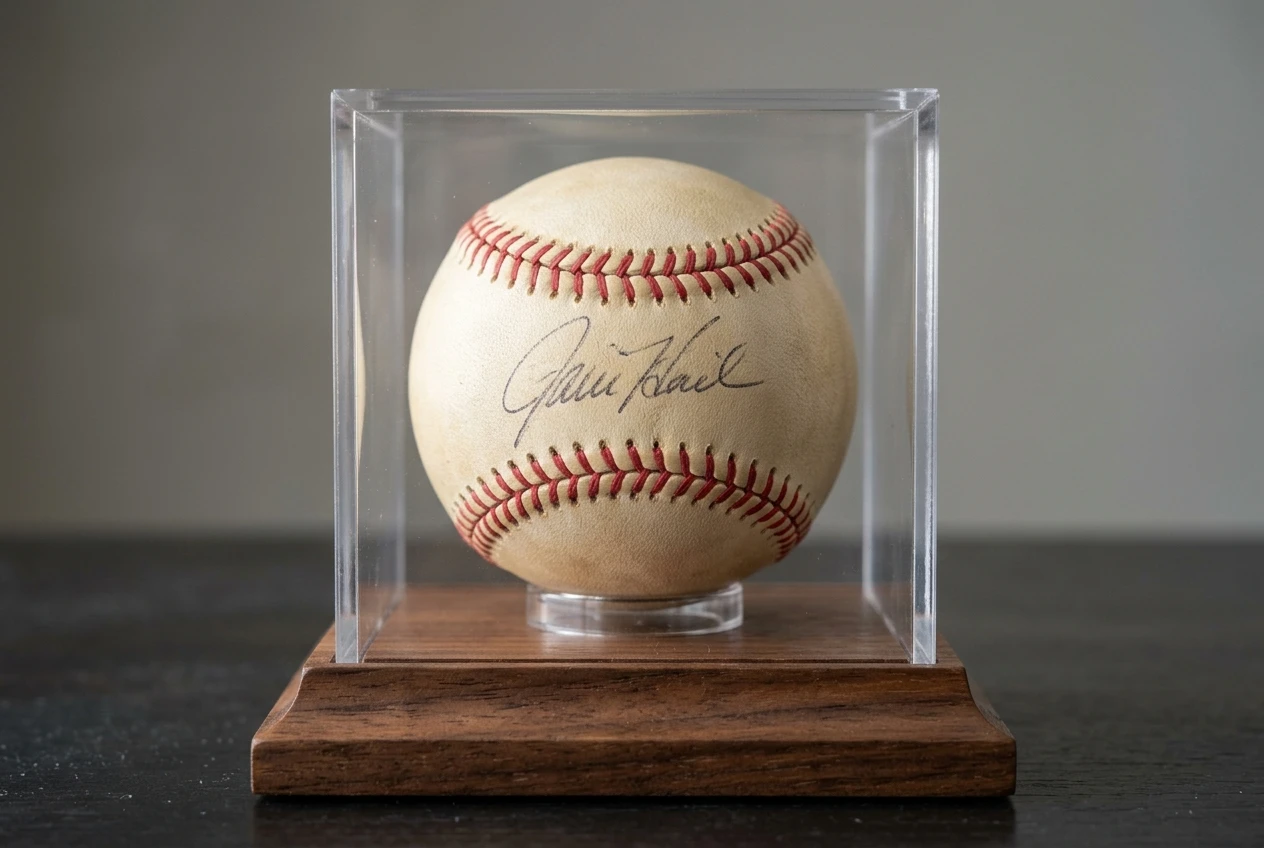
Cubes are the simplest. The ball sits on a small base, often with a ring or cradle, and a clear cover goes over it. Check these points:
- Cover fit. The cover should seat firmly on the base without gaps. Gaps let dust in and make the case pointless.
- Interior size. The ball should not touch the walls of the cube. Contact with the cover can mark the leather and press on the signature.
- Ball position. The signature should face outward and rest clear of the cradle. If the ring touches the autograph, the signature is at risk over time.
- Base stability. A light base tips over when bumped. A broad, weighted base is safer on a shelf where people walk past.
Stands with a cover work well if you want to show the ball from several sides. They are also usually the better pick for a ball with writing on more than one panel, such as a team-signed ball. The same rules apply: no contact with the cover, a signature that is not under the mount, and a tight seal.
One more point: stacking. Some cubes are designed so another one can sit on top, and many are not. A cube not built for stacking can crack or bow under the weight above it, and a bowed cover can press on the ball inside. If space is tight, buy cubes labeled as stackable or give each one its own shelf space.
Wall-mounted and multi-ball cases for a full collection
Once you own more than a few signed balls, single cubes take up a lot of room. Multi-ball cases solve the space problem, and they also put every ball behind one UV-filtering front instead of several covers of mixed quality.
Wall-mounted cases hold several balls in a row or grid, each in its own recess or on its own post. They keep the balls off shelves, away from bumps and out of reach of curious hands. Their weak points are the mounting and the weight. A case with a dozen balls is heavy. Before you buy, check the hanging hardware and the type of wall you have. A hollow drywall wall needs the right anchors or a stud, and a case coming off the wall is the worst outcome of all.
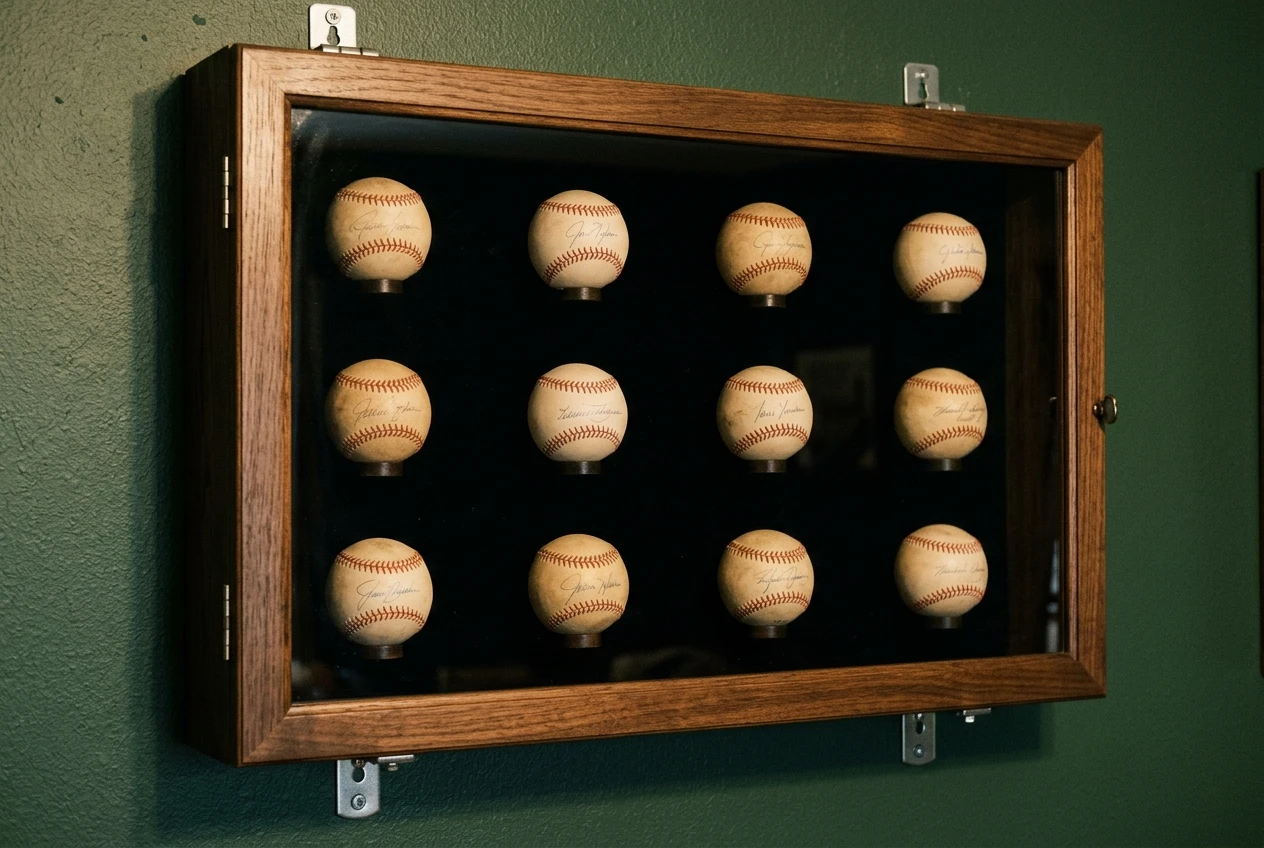
Shelf-standing multi-ball cabinets suit collectors who want to rotate balls in and out. If you choose one, look for a door that closes against a seal, a lock if children or visitors are around, and shelves that do not sag. Sagging shelves are a sign the case was not built for the load.
For both types, check that:
- every ball has its own mount, so balls do not rest against each other;
- the front panel has a stated UV rating, and the back and sides are not clear glass or plastic that lets light in at an angle;
- you can open the case without handling the balls more than you have to.
Features that matter: seals, mounts, backing and base
Four features separate a good case from one that only looks good in a photo.
Seals. A gasket, lip or tight-fitting edge keeps out dust. Run a finger around the seam in the product photos and read the description. If the cover just sits on top of the base with a visible gap, dust will get in.
Mounts. The mount should hold the ball by contact points that do not touch the signature, and it should use a smooth, non-reactive material. Avoid any mount where adhesive, tape, or soft foam touches the ball, since those can leave residue or mark the leather. If you are unsure of a material, ask the seller what it is.
Backing. In a wall case, the backing color changes how the ball looks and how much light reaches it. A solid backing also blocks light from behind. Pick one that does not press against the ball and is not made of something that will transfer color onto leather.
Base. A heavy, stable base protects the ball from knocks. A flat base that sits level on a shelf matters more than a decorative one. Felt or rubber pads under the base also keep it from sliding and scratching your furniture.
Make sure the ball is dry before you close any sealed case, and avoid sealing it into a space that has been damp. Trapped moisture is hard to spot until the damage is done.
Where to put the case so the light doesn’t undo it
A good case in a bad spot loses much of its value. The placement rules are simple.
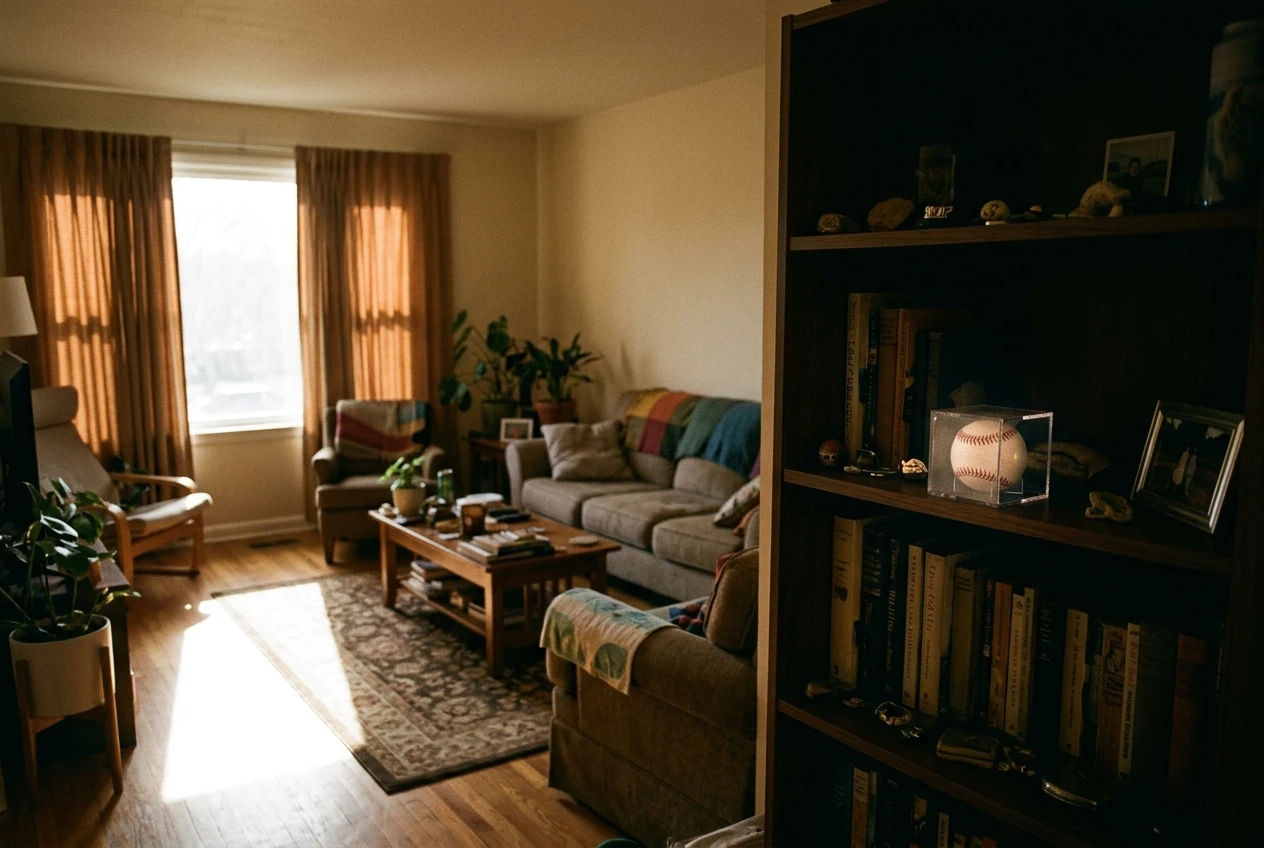
- Keep it out of direct sunlight. A window that gets sun for part of the day is not a safe place, even with a UV-filtering cover, because sun also adds heat.
- Watch where the light moves. A spot that is shaded in the morning can be sunlit in the afternoon, and the angle changes with the season. Check the spot at different times of day before you commit.
- Mind your bulbs. Place the case away from bright spotlights and bare bulbs. If you want the ball lit, use lighting that gives off little UV, keep it at a distance, and switch it off when nobody is looking at the shelf.
- Choose the room carefully. Pick a stable, dry, moderate room. Skip the garage, the attic, and any wall that gets cold and damp.
- Rotate if you must. If a display location gets more light than you would like, move the balls you care about most to a shadier spot, and keep a photo of how each ball looked when you put it on display. That photo is useful later when you describe its condition.
How the right case helps when you list the ball for sale
Buyers of signed baseballs pay close attention to the autograph’s clarity, the leather’s color and any signs of wear. A ball that has spent years in a sealed, UV-filtering case in a dim room is easier to describe honestly and easier for a buyer to trust. The signature is darker, the leather is cleaner, and you can say how it was stored.
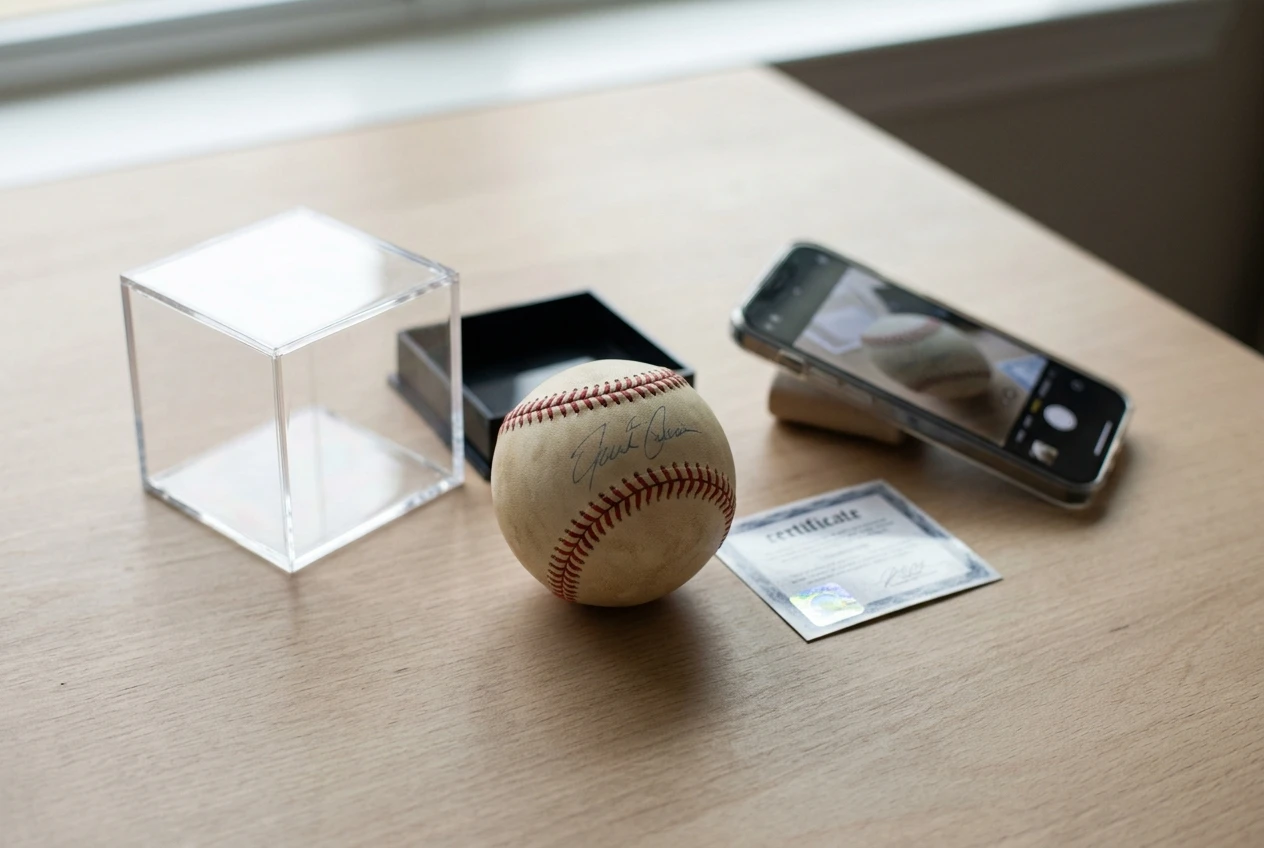
The case also helps you photograph the ball. A clean case with a stable base lets you take clear shots from several sides before you list. Take pictures of the signature, the stitching, any certificate or hologram, and the case itself, and say plainly what you know about condition. Condition details do more for a sale than any adjective.
If the case is in good shape and fits the ball, consider offering it with the ball, and say so in the listing. A buyer who wants to keep displaying the ball will value it, and it shows the ball has been cared for. Avoid claiming that the case guarantees condition or boosts the price by any set amount, because buyers read that as a sales line. Describe the case, describe the ball, and let them judge.
Which case fits which ball: a quick pick list
Use this list as a starting point, then check each case against the features above.
- One signed ball you want to enjoy at home: a UV-filtering acrylic cube with a tight-fitting cover, a stable base and a mount that keeps the signature clear.
- A World Series ball or another high-value ball: the best UV-filtering case you can verify, with a sealed cover, a mount that does not touch the autograph and a spot well away from windows. Keep any certificate of authenticity stored safely with it and photograph it for your records.
- A team-signed ball with several signatures: a stand or cube that lets you rotate the ball without touching it, so you can show different panels and keep the ball off any one signature for long.
- A shelf of autographed balls: a wall-mounted or cabinet multi-ball case with individual mounts, a stated UV rating on the front, and sturdy hanging hardware or shelves.
- A ball you plan to sell soon: a clean, sealed single case, which keeps it protected and makes photography simple.
- A tight budget: a basic cube for dust and handling protection, kept in a dim room, and an upgrade to a UV-filtering case once you can confirm the rating on one.
Ready to sell a ball you’ve kept safe? Put it up for sale with your photos and condition details, using our guide on how to list sports memorabilia for sale.
Leave a Comment